Posts

Mutual Fund

Mutual Fund - These days you are hearing more and more about mutual funds as a means of investment. If you are like most people, you probably have most of your money in a bank savings account and your biggest investment may be your home. Apart from that, investing is probably something you simply do not have the time or knowledge to get involved in. You are not the only one. This is why investing through mutual funds has become such a popular way of investing. A mutual fund is a pool of money from numerous investors who wish to save or make money just like you. Investing in a mutual fund can be a lot easier than buying and selling individual stocks and bonds on your own. Investors can sell their shares when they want. Professional Management.   Each fund's investments are chosen and monitored by qualified professionals who use this money to create a portfolio. That portfolio could consist of stocks, bonds, money market instruments or a combination of those. Fund Ownershi...
What factors should be kept in mind while evaluating the cost of securities in todays economic environment?

What factors should be kept in mind while evaluating the cost of securities in todays  economic environment? Security analysis is the basis for rational investment decisions. If a security’s estimated value is above its market price, the security analyst will recommend buying the stock. If the estimated value is below the market price, the security should be sold before its price drops. However, the values of the securities are continuously changing as news about the securities becomes known. The search for the security pricing involves the use of fundamental analysis. Under fundamental analysis, the security analysts studies the fundamental facts affecting a stock’s values, such as company’s earnings, their management, the economic outlook, the firm’s competition, market conditions etc. Fundamental analysis is primarily concerned with determining the intrinsic value or the true value of a security. For determining the security’s intrinsic value the details of all major fac...

What is new issue? Who are the key players involved?

What is new issue? Who are the key players involved? New Issue Market (NIM) comprises all people, institutions, methods/ mechanism, services and practices involved in raising fresh capital for both new and existing companies. This market is also called Primary Market. NIM helps raising resources from the investors by issuing them only new or fresh securities. Thus, NIM facilitates direct conversion of savings into corporate investment or diversion of resources from the rest of the system to the corporate sector. Primary market deals in only new securities i.e., which were not available previously. They are offered to the investors for the first time. The issuing houses, investment bankers, and brokers act as the channel of distribution for the new issues. On the other hand, secondary market or stock market or stock exchanges deal in existing securities, i.e., securities which have already been issued by companies and are listed with the stock exchanges. Relationship between ...

Discuss the methods of valuation of variable income securities?

Image
Discuss the methods of valuation of variable income securities? The term variable-income security refers to investments that provide their owners with a rate of return that is dynamic and determined by market forces.  Variable-income securities provide investors with both greater risks as well as rewards. Variable-income securities, also known as variable-rate securities, are typically valued by investors looking for higher returns than those offered by fixed-income securities.  The classic example of a variable-income security is common stock, which can offer investors virtually unlimited up-side growth as well as the complete loss of principal.  In exchange for this risk, investors in these securities demand higher returns than their fixed-income counterparts.  In addition to common stocks, examples of variable-income securities include: Equity shares are floated in the market at face value, or at a premium or at a discount. Only companies with a trac...

Compare and contrast preference share and equity share? Briefly explain the techniques for valuation of equity shares?

Image
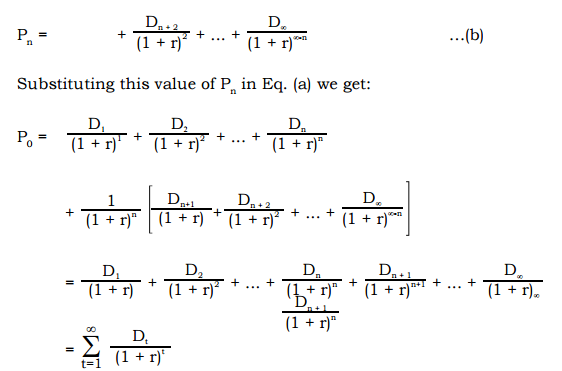
Compare and contrast preference share and equity share?  Briefly explain the techniques for valuation of equity shares? Equity shares are the ordinary shares of the company. The holder of the equity shares are the real owners of the company, i.e. the amount of shares held by them is the portion of their ownership in the company.Equity shareholders have some privileges like they get voting rights at the general meeting, they can appoint or remove the directors and auditors of the company. Apart from that, they have the right to get the profits of the company, i.e. the more the profit, the more is their dividend and vice versa. Therefore, the amount of dividends is not fixed. This does not mean that they will get the whole profit, but the residual profit, which remains after paying all expenses and liabilities on the company. Preference Shares, as its name suggests, gets precedence over equity shares on the matters like distribution of dividend at a fixed rate and repayment ...